Measured Against Reality

Wednesday, August 22, 2007

Hints of a breakdown of special relativity

When I saw the article titled "Hints of a breakdown of special relativity" in a SciAm blog, my curiosity was piqued. I thought it was just going to be the old, debunked story, but it's not.

The team from the MAGIC gamma-ray telescope has some tantalizing evidence that, in fact, special relativity is incorrect. They found indications that high-energy gamma rays travel slower through vacuum than low-energy rays. Here's the meat of the observation:

The team studied two gamma-ray flares in mid-2005 from the black hole at the heart of the galaxy Markarian 501. They compared gammas in two energy ranges, from 1.2 to 10 tera-electron-volts (TeV) and from 0.25 to 0.6 TeV. The first group arrived on Earth four minutes later than the second. One team member, physicist John Ellis of CERN, says: "The significance of the time lag is above 95%, and the magnitude of the effect is beyond the sensitivity of previous experiments."


Now, why exactly this would happen is way beyond my understanding. According to SciAm, it could be that there's some kind lensing that occurs due to fluctuations in the fabric of space-time that happens at higher energies. (It sounds almost like increasing air resistance with speed, perhaps that's a good metaphor the proposed effect?) This kind of effect can happen in theories of Quantum Gravity, and if this result is real, it could help constrain the possible "theory of everything".

However, it needs to be said that this is a big claim, and it could be totally wrong. There need to be thorough checks done on the work, and it would be nice if a separate lab confirmed the result. But if it stands, this could well be one of those turning points in modern physics. I can't wait to hear more, new physics is very exciting! (Or at least it is when it's possibly a real result.)

Labels: , , ,

Friday, August 17, 2007

Speed of light still not broken, but now we really know why

I'm glad I read Physics blogs, because they always know more than me. Check that out if you want a very detailed backstory to yesterday's "Speed of light NOT broken" story. It turns out that the only person who thinks that SR was violated is someone who has a history of making more of these experiments than they deserve, and that the paper that's available is totally inadequate for the claims that are being made. So basically I was right (it happens from time to time).

So check that out if you care at all about the speed of light and superluminal information transfer.

Labels: , ,

Thursday, August 16, 2007

We have NOT broken the speed of light

We have broken the speed of light, the article's headline boldly proclaims.

No, we haven't. I absolutely guarantee it. First, let's look at what they did:

The pair say they have conducted an experiment in which microwave photons - energetic packets of light - travelled "instantaneously" between a pair of prisms that had been moved up to 3ft apart.


Well there's not really anything here. My first guess was that this was some issue about Quantum Entanglement, but it might not be (and that doesn't offer FTL communication anyway, that's just a sloppy interpretation of what's happening). If this is about entanglement then it's not news, this has been done dozens of times, and it doesn't break SR.

But if it's not about entanglement it doesn't matter, because there's no way light traveled faster than light. It reminds me of someone who asked me if humidity can be above 100%. My response was, "No, because can't hold more water than it can possibly hold."

Light always travels at the speed of light, and the speed of light varies based on the medium the light is in. This comes straight from Maxwell's Laws (see here if you're interested in why), and it's what inspired Einstein to think about what light would look like if you ran alongside it (of course, he figured out that no matter how fast you were running it would still go at the speed of light). Special relativity comes straight from Maxwell's laws, and if something is found to violate SR, then Maxwell's laws aren't correct.

Now, it's always possible that our current knowledge of the universe isn't correct, even something as old and well-established as the fundamental theory of electricity and magnetism. But the more established and well-tested the theory, the less likely this becomes. It's like evolution, sure it could be wrong, but it almost certainly isn't. The same is true of Maxwell's Laws, they've been so thoroughly tested to such insane limits that if they're wrong it would shake physics to its core (given that those four little equation form an entire section of physics, and form the foundation for relativity, one of the two pillars of modern physics, the other being QM).

So while it's possible that these two researchers have broken the speed of light, I highly doubt it. Besides, if you look at their setup the have light traveling one meter, which happens in about 3 nanoseconds. I think it's more likely that they measured incorrectly (that there's some error in their experiment) than that half of modern physics is wrong. If I never hear about this monumental discovery again, I'll be pretty sure that I'm right.

Update: A different article has more information, this one attributes the FTL travel to quantum tunneling, which is a process by which a particle goes through an energy barrier that it classically shouldn't be able to go through. I'm not very experienced with this phenomenon, but my understanding is that this still doesn't violate SR since it's not actually moving that distance, the wavefunction has just spread over to the other detector. Since the wavefunction covered the whole distance anyway, the particle wasn't localized before measurement, so it can't be said to have traveled FTL in any real sense (keep in mind that could all be wrong). But it's so hard to say what's going on based on these news reports, they don't include reference information and I can't see it here anyway, so I can't check any actual paper for an idea of what's going on.

In any case, I still stand by my original assessment that this isn't revolutionary, but as always, I could be wrong.

UPDATE 2: Wow, I should have checked Eureka Alert a while ago. Here's a reasonable explanation of what happened. It was indeed tunneling, and it also does not violate SR. As is typical with science reporting, the reporter seized upon the most fantastic interpretation of the results, and not the sober analysis presented at the end. We did not break the speed of light, end of story.

Labels: , , , , ,

Tuesday, May 29, 2007

Why Special Relativity is Obvious

I’ve been meaning to write this post about why special relativity is obvious for a while, and since the new Microsoft Word comes with equation writers, I’ve got an excuse to finally do it.

Special Relativity is a favorite whipping boy among cranks. You’ll see attempts to disprove it all the time (I got one in my inbox a few weeks ago). It also has a reputation as being difficult to understand. I hope to address both of those with this post.

I was in my electrodynamics lecture, and the professor was going through the derivation of wave solutions to Maxwell’s equations in a vacuum (if you’re interested, the derivation is here, with H in place of B, for some weird reason). The final product is below (which is where Word’s new equations came in handy).


Which is immediately recognizable as a wave traveling with speed c. This is pretty easily derived for waves in matter too (with D and H replacing E and B respectively. D and H are simply the electric and magnetic fields in matter, and for most materials end up being just a factor different, which leads to a different propagation velocity).

So what? Everyone knows that electromagnetic waves exist. And what does this have to do with relativity?

Well, for those not familiar with it, special relativity has two postulates, the rest of the theory rest on their back. The first is that there exist inertial reference frames, and the laws of physics are the same in all inertial frames (a frame is more or less just a coordinate system with a clock (so you can measure position and time), and an inertial frame is defined as one where the laws of physics hold, so the second part is something of a tautology). This postulate is hard to argue with, you’d essentially be saying that physics is invalid.

So if a frame is inertial (like say, the one you’re in while you’re sitting at your computer reading this), then any frame moving with a constant velocity relative to it is also an inertial frame. How do we know that? Because if you’re moving with constant velocity in a closed train (meaning you can’t see the outside), there’s no way to tell that you’re moving. You might not believe this at first, but most of your cues that you’re moving come from tiny accelerations, you really can’t tell when you’re moving with constant velocity; it’s impossible, which means that it’s an inertial frame.

The second postulate is more interesting, and that is that the speed of light is the same in all inertial frames. But this is obvious: I just showed above that Maxwell’s equations have waves that propagate with speed c, and since Maxwell’s equations are a law of physics they’re true in all frames. That means that an observer in any inertial frame must see light moving at speed c, no matter how they’re moving relative to anything else.

I think we should really speak of the postulate of relativity, because the second comes naturally from the first, and it might clear up why this wacky theory has to be correct (and is totally obvious).

Of course, the consequences of this aren’t obvious at all: Time Dilation, Lorentz Contraction, the relativity of simultaneity, the weird addition of velocities, and everyone’s favorite: the equivalence of mass and energy. Those are all truly bizarre consequences, but they have to be true, and they’re Einstein’s brilliant insight. I’m not going in to them now, the Wikipedia articles should satisfy the curious , but they have to be true given the two postulates.

Or, at least, they have to be true if Maxwell’s equations and the rest of physics is correct. If Maxwell were wrong pretty much no modern technology would work, rendering that highly implausible. So unless you think that inertial frames don’t exist, you must think that special relativity is correct. I hope I’ve made it clear exactly why this is true.

Labels: , ,

Monday, December 11, 2006

Nothing Can Move Faster Than Light

As a physicist-in-training, seeing physics misrepresented gets me angry. Some of the most common misrepresentations of physics involve the speed of light.

Occasionally I’ll see over-zealous headlines that proclaim “Scientists send [something] faster than light!” This is completely impossible. To explain why, we have to deal with Einstein’s theory of special relativity.

The speed of light (c) is hardwired into Maxwell’s equations, the equations governing electricity and magnetism. It is the speed at which light propagates in a vacuum, 2.99792 m/s. It’s a very fundamental constant.

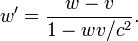
There are three main reasons that no massive particle can move faster than (or at) the speed of light, the first has to do with velocity addition. In relativity, velocities don’t add simply, they follow the formula:


Close inspection of this formula reveals that nothing can accelerate to the speed of light by velocity addition. C is quite literally the speed limit.

Another reason has to do with energy. In relativity, the energy of a particle is equal to:


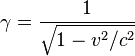
where the factor gamma is equal to:


As v approaches c, gamma approaches infinity, and so does the energy of the particle. That means any particle that has any mass needs infinite energy to move at the speed of light, which is impossible.

The last reason that nothing can move faster than c is that it would make gamma imaginary, which would render every equation of special relativity unintelligible.

You might have noticed that everything I said above only applies to massive particles, but the story is pretty much the same for massless particles, except they can only move at the speed of light.

What’s usually going on with those headlines is that the researchers have “slowed light down”, which is misleading as well, because light always moves at the speed of light. The only way it can be slowed down is by entering a medium with an index of refraction that’s greater than one (which is why I previously said “the speed of light in a vacuum”). Slowing light down in this way is possible, and it happens all the time. It’s why things appear to bend at the water-level (which has an index of refraction of about 1.3).

I’ve read articles that claim researchers got messages to arrive before they were sent by altering the speed of light, but it’s just not possible. These usually turn out to fit the mold of the aforementioned “index of refraction” changes. Besides, there’s no good reason to believe that causality can be broken, and no current theory allows it.

In short, nothing can move faster than light, get over it.

Labels: , , ,